Executive Function and Self Regulation: How do I Self Manage More Easily?
Inside: Strategies and tools to help with self-management, including supporting self regulation and executive functioning
Imagine this scenario: You wake up late, realize you’re already behind schedule, and feel a wave of panic setting in.
Instead of calmly planning your next steps, you:
rush through your morning
forget important items
arrive at work frazzled
While we often think of self-regulation practice as something children need to worry about, it affects everyone, including adults. When things go wrong, such as when you oversleep, your self-regulation skills are put to the test.
The example above is a classic example of poor self-regulation impacting your ability to recover from unexpected setbacks.
When executive function and self-regulation are not working in tandem, even minor hiccups can derail your day.
In the fast-paced world we live in, the ability to manage oneself with efficiency is more critical than ever. From meeting deadlines to maintaining personal relationships, executive function and self-regulation play pivotal roles in our everyday lives.
But what happens when these skills are not developed in full?
How can we support individuals who struggle with these areas? [See our video on classroom supports for Executive Function]
Let’s look at executive function and self-regulation, their interaction, and explore strategies and assistive technologies that can make a significant difference.
Table of Contents
Understanding Executive Function
The Interaction Between Executive Function and Self-Regulation
Strategies to Improve Executive Function and Self-Regulation
!["Executive Function and Self Regulation: How do I Self Manage More Easily?" [a meditating woman surrounded by images of her responsibilities]](https://images.squarespace-cdn.com/content/v1/5fb875a443d09d68b8eb3c98/2a2b9aa8-0f23-4800-8e92-bde26c65cac9/executive+function+and+self+regulation)
Understanding Executive Function
Executive function refers to a set of cognitive processes essential for controlling behavior and achieving goals. Think of it as the brain's management system, consisting of skills like working memory, cognitive flexibility, and inhibitory control.
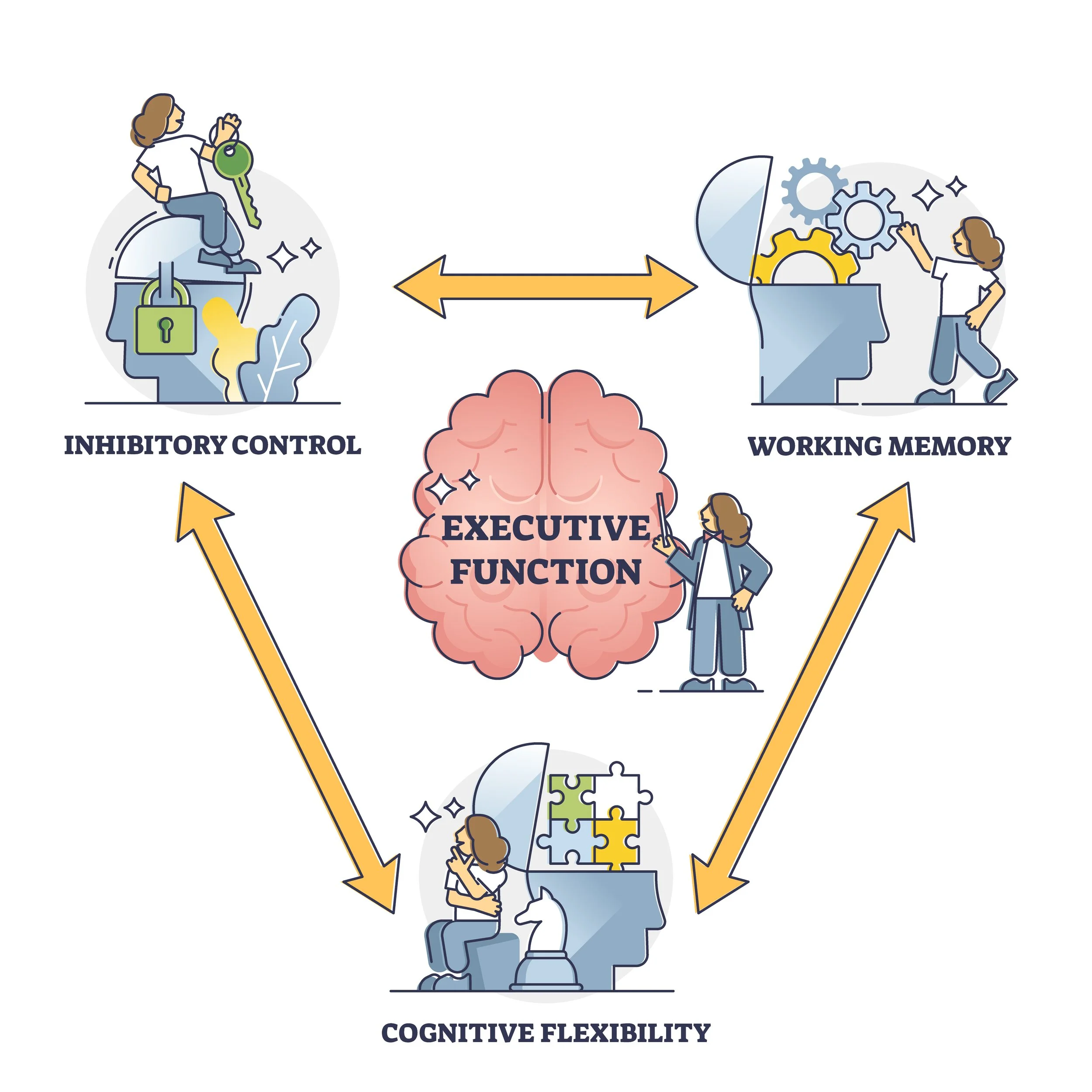
Working Memory: The ability to hold and manipulate information over short periods.
Cognitive Flexibility: The capacity to shift thinking and adapt to new situations.
Inhibitory Control: The power to control impulses and resist distractions.
Consider this: a student working on a math problem uses working memory to hold numbers in their head, cognitive flexibility to switch strategies if one isn't working, and inhibitory control to ignore distractions and stay focused.
Without these skills, even simple tasks can become overwhelming.
Understanding Self-Regulation
Self-regulation is about managing one's emotions, behaviors, and thoughts in pursuit of long-term goals.
Self-Regulation keeps us on track when motivation wanes or distractions abound. Self-regulation encompasses emotional regulation, behavioral regulation, and cognitive regulation.
Emotional Regulation: Managing emotions to respond with composure. [Learn about AT for Emotional Regulation here]
Behavioral Regulation: Controlling actions to align with goals.
Cognitive Regulation: Adjusting thinking patterns to stay focused and productive.
Imagine an athlete preparing for a big game. They use emotional regulation to stay calm under pressure, behavioral regulation to stick to their training regimen, and cognitive regulation to maintain a positive and focused mindset.
The Interaction Between Executive Function and Self-Regulation
Executive function and self-regulation are interconnected on a deep level.
Deficits in executive function can severely impact an individual's ability to self-regulate, and vice versa.
For instance, a student who struggles with working memory might find it hard to keep track of homework assignments, leading to stress and poor academic performance. Conversely, poor self-regulation can hinder the development of executive function, creating a vicious cycle.

Strategies to Improve Executive Function and Self-Regulation
Routine Building
Establishing and sticking to routines can provide a structured environment which supports both executive function and self-regulation. Consistent routines help in building habits to automate decision-making processes, reducing cognitive load.
Goal Setting

Setting realistic and achievable goals is crucial. Breaking down larger goals into smaller, manageable tasks can make them less daunting and more attainable, promoting a sense of accomplishment and motivation.
Mindfulness Practices
Incorporating mindfulness practices such as meditation can altogether enhance self-regulation. Mindfulness helps in developing greater awareness and control over one's thoughts and emotions, leading to better decision-making and impulse control.
[Learn about more ways to aid difficulties with executive function]
Assistive Technologies
Apps for Organization
Apps like Trello, Todoist, and even built in reminder apps can be lifesavers for individuals struggling with executive function. These tools help in organizing tasks, setting priorities, and tracking progress, making it easier to stay on top of responsibilities. [see more about digital supports here]
Timers and Reminders
Using digital timers and reminder apps such as those built into cellular phones can enhance focus and productivity. Tools like Google Keep can help in setting reminders for important tasks and deadlines.
Writing and Note-Taking Tools
Tools like Notes, Rocket Book, and even low-tech paper post-it notes support writing and note-taking, which are critical for organizing thoughts and information. These tools help in capturing ideas faster and structuring them effectively.
Mastering the Balancing Act

Executive function and self-regulation are the cornerstones of effective self-management. By understanding their components, recognizing their interaction, and using strategies and technologies, individuals can unlock their full potential. Start small, be consistent, and explore which tools and techniques work best for you.
Are you ready to learn more about Executive Functioning? Download our free Executive Functioning Checklist
FAQ Section
Q: What are some quick tips for improving executive function?
Start with small, manageable goals.
Use organizational tools like planners or apps.
Practice mindfulness to enhance focus.
Q: How can I support a child struggling with self-regulation?
Establish clear routines.
Encourage breaks and physical activity.
Introduce mindfulness exercises suitable for their age.
Q: Are there free tools available for organization and self-regulation?
Yes, tools like Google Keep and built in phone and computer apps are excellent for organization. You can also find free meditation apps like Calm.





Wondering whether assistive technology would help in your situation?
Innov-AT provides assistive technology assessments, training, and implementation support across Wisconsin — for students, adults, schools, agencies, and employers. If someone in your life is struggling with a task, we can tell you in a short call whether AT is likely to help.